4V210-08 Solenoid Valve FAQ: 3C Assembly Lines, Manifold Integration and How to Choose
Estimated reading time: 7 minutes
A buyer's FAQ on the Kailing 4V210-08 5/2-way pneumatic solenoid valve — voltage options, manifold (return-plate) integration, and what matters on high-cycle 3C electronics assembly lines. Prepared by Ningbo Kailing Pneumatic Co., Ltd. (KLQD).
Part 1 · Product Basics
Q1: What exactly is the 4V210-08?
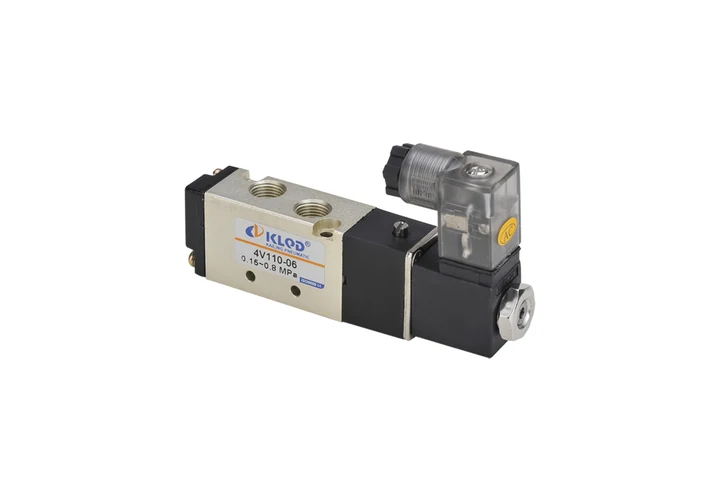
It is a 5/2-way, single-solenoid, internally piloted directional control valve from Kailing's 200 series. In plain terms: it switches a double-acting pneumatic cylinder between extend and retract, and returns to its default position by spring when power is cut. The "-08" means G1/4" ports. It is one of the most widely used valve sizes on automated assembly equipment.
Q2: How do I read the model code?
Each segment of the code tells you one configuration choice:
| Code segment | Meaning |
|---|---|
| 4V | Solenoid-operated directional valve (4A = air-piloted, 3V = 3-way solenoid) |
| 2 | 200 series |
| 10 | 2-position, 5-port, single solenoid, spring return |
| 08 | G1/4" port size |
Related models in the same series: 4V220-08 (double solenoid, no spring return), 4V230C/E/P-08 (3-position center-blocked / center-exhaust / center-pressurized), and 4V210-06 (G1/8" small-port version). Thread standards G, ZG (BSPT) and NPT are available, which makes line retrofits straightforward.
Q3: What are the key specifications?
Per Kailing catalog page 130:
| Parameter | Value |
|---|---|
| Effective area | 16 mm² (Cv = 0.89) |
| Working pressure | 0.15 – 0.8 MPa (max 1.2 MPa) |
| Max switching frequency | 5 cycles per second |
| Minimum excitation time | 0.05 s |
| Voltage tolerance | ±10% |
| Coil power | DC 3 W / AC 4.5 VA |
| Insulation & protection | Class F, IP65 |
| Medium | Air filtered to 40 μm |
| Ambient temperature | 5 – 50 °C |
Part 2 · Voltage and Electrical Connection
Q4: Should I choose DC24V or AC220V?
For 3C assembly lines, DC24V is the default choice. PLC outputs, I/O blocks and sensors on electronics assembly equipment almost universally work at 24 VDC, so the valve coil can be driven directly from the PLC output — no interposing relays, fewer wiring faults, cleaner cabinets.
AC220V still has its place: older line retrofits, standalone auxiliary equipment, or stations supplied directly from mains power. Since the valve is offered in both, one valve family can cover new-line design and legacy-line maintenance at the same time.
Q5: Can the valve tolerate unstable plant power?
Yes. The coil accepts a ±10% voltage range, and the DC24V coil draws only 3 W. Low coil power matters on valve islands where dozens of solenoids sit side by side — less heat build-up, longer coil life, and lower energy consumption across thousands of cycles per shift.
Q6: What wiring options are available?
Four forms: standard terminal block, LD (LED indicator, terminal), LD1 (white LED, terminal) and W (lead-wire). The LED variants are popular on 3C lines because maintenance staff can see at a glance which station is energized when debugging.
Part 3 · Why It Fits 3C Assembly Lines
Q7: Our line runs fast. Can it keep up?
Yes — that is precisely where this model earns its keep. 5 cycles per second maximum switching frequency combined with a 0.05 s minimum excitation time means short PLC pulses are executed cleanly. Pick-and-place, pressing, flipping and screwdriving stations that cycle several times per minute per axis are well within its envelope, and the 16 mm² (Cv 0.89) orifice fills and exhausts cylinders quickly, keeping stroke time short and takt tight.
Q8: What air quality does it need?
Ordinary plant air filtered to 40 μm is sufficient — a standard FRL unit (filter-regulator-lubricator) upstream covers it. Operating pressure 0.15–0.8 MPa matches typical workshop supply. No special preparation is required, which simplifies integration into existing 3C line infrastructure.
Q9: Is it suitable for the dusty, humid reality of a factory floor?
The valve carries IP65 protection and Class F insulation, so it resists dust and typical electronics-plant humidity. Ambient range 5–50 °C covers normal shop-floor conditions without additional cooling measures.
Part 4 · Manifold Integration with Return Plates
Q10: Can 4V210-08 valves be ganged into a valve island?
Yes. The valve supports base (plate) mounting: valves are carried on a manifold base — often called a return plate — that provides common supply and common exhaust for the whole row. Individual valves snap onto the plate; no individual piping per valve.
Q11: Why is a manifold island better than individual in-line valves on a 3C line?
Four practical reasons:
- Drastically fewer tubes — one air supply line and one exhaust line serve the whole island instead of one pair per valve, cutting installation time and leak points.
- Cleaner electrical routing — solenoid heads align in a row; with terminal or LED wiring forms, debug points are visible and reachable in one place.
- Minutes, not hours, to replace a valve — a faulty valve unclips from the manifold without breaking pipework. On 3C lines where downtime is measured in lost units per minute, this is the single biggest maintenance advantage.
- Space saving — islands mount flat against machine frames and inside guarding, which suits the compact, fully-shrouded layout typical of electronics assembly equipment.
Q12: How many stations should our island have?
A common rule of thumb: number of working stations plus 10–20% spare positions for future function additions. Kailing can supply manifold bases configured to your station count, port pattern and blanking requirements — send the station list or machine drawing with your RFQ.
Q13: Can DC24V and AC220V coils coexist on one island?
Yes — each valve position takes its own coil voltage. That said, we recommend keeping one control circuit on one voltage system wherever possible, to reduce mis-wiring risk during maintenance.
Part 5 · Choosing the Manufacturer
Q14: Who is Kailing, and why buy from the factory?
Ningbo Kailing Pneumatic Co., Ltd. (KLQD) has manufactured pneumatic components in Xikou Industrial Park, Fenghua, Ningbo since 2003. Valve body machining, assembly and testing happen under one roof, so specification consistency, OEM adjustments and technical answers come directly from the people who make the valve — not a trading desk.
Q15: What quality documentation is available?
- ISO 9001 certified quality management system
- CE (EMC) verification for solenoid valve series
- Current RoHS reporting
- Test reports and documents supplied with the quotation on request
Q16: Do you support OEM or customized configurations?
Yes. Voltage, coil, wiring form, port thread, markings and packaging can be tailored. For 3C equipment builders with recurring needs — uniform wiring forms across a machine fleet, custom voltage labels, station-numbered engraving on manifold positions — Kailing provides series-level OEM support from drawing review to repeat orders.
Q17: How fast is the response and delivery?
Technical questions are answered the same day; standard quotations are returned within one working day. The 200 series is a stocked line, so repeat orders hold stable lead times — an important factor when your own delivery date to the end customer is fixed.
Q18: How do I get a quotation?
Send the following to Kailing sales, and you will have a quotation and manifold configuration proposal within one working day:
- Model: 4V210-08 (or 4V220-08 / 4V230C-08 / 4V210-06 as applicable)
- Voltage: DC24V or AC220V (state 50/60 Hz where relevant)
- Wiring form: terminal / LD / LD1 / W
- Thread standard: G / ZG / NPT
- Mounting: individual base or manifold island (station count + spare positions)
- Quantity, target delivery, destination country
Quick Answers (TL;DR)
- 3C assembly lines → choose DC24V for direct PLC drive; AC220V covers retrofits.
- High takt → 5 Hz switching, 0.05 s excitation, Cv 0.89 flow.
- Wiring and plumbing → manifold island on return plates: fewer tubes, faster valve swap, smaller footprint.
- Sourcing → factory-direct from Kailing: ISO 9001, CE, RoHS, OEM/ODM, 1-working-day quotes.
Contact · Ningbo Kailing Pneumatic Co., Ltd. — No.13 ZongYan Road, Xikou Industrial Park, Fenghua, Ningbo, Zhejiang, China · since 2003
Specifications quoted from Kailing catalog page 130 (200 series directional valves). Final model selection should be confirmed against actual working conditions before ordering.
Need a quotation?
Send the page link, quantity, drawings and working conditions to Kailing for review.