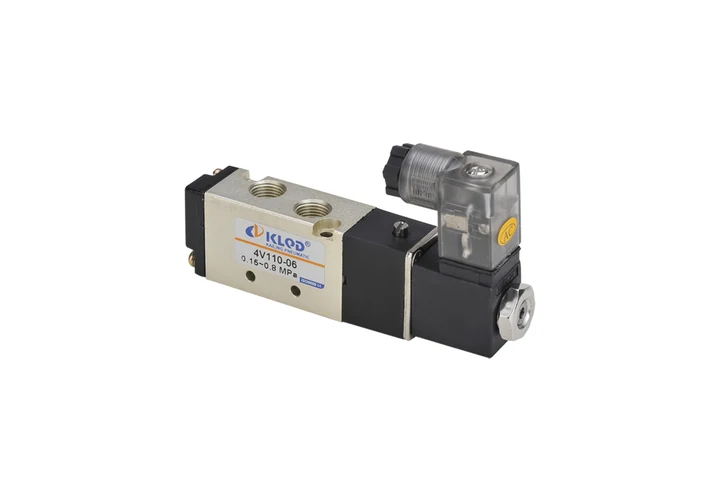
Direct Answer
A 5/2 way solenoid valve switches a double-acting pneumatic cylinder between extend and retract using five ports and two positions. A 5/3 way valve adds a center position — closed, exhaust or pressurized — so the cylinder can stop mid-stroke. For 1/8" to 1/2" automation circuits, confirm function, port size, coil voltage and center behavior before ordering.
What a 5/2 Way Solenoid Valve Does
A 5/2 way valve is the standard control valve for a double-acting pneumatic cylinder: five ports (supply, cylinder A and B, two exhausts) and two positions decide which cylinder port is pressurized. Energize the coil and the piston extends; lose power and a spring-return model shifts back so the cylinder retracts. Where a cylinder simply cycles between two end positions, one 5/2 valve per actuator is usually all the circuit needs; a double-solenoid 5/2 holds its last position on power loss, useful for axes that must not drift.
When a 5/3 Way Valve Is the Better Choice
Specify a 5/3 way valve when the cylinder must stop between end positions. The center position comes in three types: center-closed traps air so the cylinder holds; center-exhaust vents both cylinder ports so the piston can be moved by hand; center-pressurized applies supply to both ports. Use center-closed for grippers and positioning slides that must hold; treat center-exhaust as a manual-jog convenience, not a safety function. Which center type you need is an engineering decision — confirm it with your machine designer before ordering.
Buyer Checklist Before You Order
Confirm these six points before ordering:
| Parameter | What to confirm | Why it matters |
|---|---|---|
| Valve function | 5/2 single solenoid, 5/2 double solenoid, or 5/3 center type | Sets cylinder behavior on power loss |
| Port size | 1/8", 1/4", 3/8" or 1/2"; BSPP, BSPT or NPT thread | Must match cylinder flow demand and piping |
| Coil voltage | 24 VDC, 110 VAC or 220 VAC (per model) | Wrong voltage is the top cause of burned coils |
| Mounting | Individual body or manifold base | Manifolds cut piping and speed replacement |
| Pilot type | Internal pilot standard; external pilot for low pressure | Internal piloting needs minimum supply pressure to shift |
| Air preparation | Filter-regulator or FRL upstream | Clean, dry air prevents most valve failures |
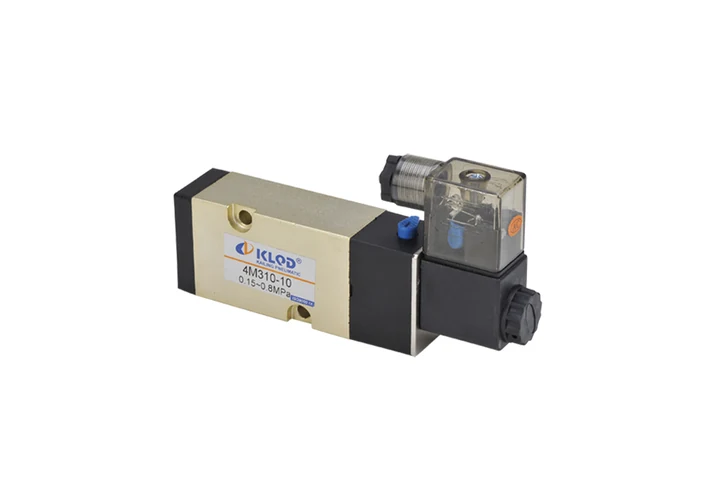
Matching Kailing 4V Series Valves to Your Cylinder
Size the valve to the cylinder, not the other way around. Bore and stroke set the air volume per cycle; the valve's port size and flow capacity set cycling speed. As a working range, the Kailing 4V series covers 1/8" through 1/2": the compact 4V100 series suits small cylinders and tight manifolds, while the 4V300 series handles larger bores and faster cycles. If a cylinder runs slower than the takt requires, move up one port size rather than raising supply pressure. For exact flow values and model-to-port mapping, ask us to size the valve for your bore, stroke and cycle rate.
Voltage, Wiring and European Plant Practice
For PLC-controlled machines in Germany and wider Europe, 24 VDC coils are the default choice: they connect directly to low-voltage I/O and simplify wiring. 220 VAC (110 VAC on request) remains common on relay-panel and retrofit lines. Confirm connector style (DIN plug or lead wire) per model. Coil options and electrical ratings vary by model and can change, so verify against the current datasheet before purchase.
FAQ
What is the difference between a 5/2 and a 5/3 way solenoid valve?
A 5/2 valve has two positions and moves a double-acting cylinder between full extend and full retract. A 5/3 valve adds a center position that can block, exhaust or pressurize both cylinder ports for mid-stroke stop or hold. Use 5/2 for simple cycling; use 5/3 when the actuator must pause between ends.
Which port size do I need for my pneumatic cylinder?
Match the valve to cylinder bore and required cycle time. Small cylinders with modest speed requirements normally work with 1/8" or 1/4"; larger bores or fast cycles need 3/8" or 1/2". Send bore, stroke and cycles per minute and we will confirm the port size and model.
What MOQ and lead time apply to 4V series valves?
Minimum order quantity and delivery time depend on model, coil voltage and order volume, and are confirmed per inquiry rather than listed as fixed figures. Contact Kailing sales with your model list and destination for a current quotation and schedule.
Can I get drawings or samples before ordering?
Yes. Request dimensional drawings and datasheets for the model before ordering, and ask about sample availability for bench testing. Share your cylinder parameters and target cycle rate so we can verify the selection before you commit to volume.
Which certifications apply, and how do I confirm them?
Certification requirements differ by market and application, and documents are issued per model and batch. State the certifications your plant requires when you inquire, and we will confirm current documentation in writing before shipment.
Request a Valve Selection and Quote
Whether you are standardizing on 5/2 way solenoid valves for a new automation line or need 5/3 center-closed valves for holding axes, send us your cylinder bore, stroke, cycle rate and available voltage. We will confirm the model and port size, provide drawings and a quotation, and support sample evaluation for European OEM and distributor projects via www.kailingfluid.com.
Sources
- User material: 4V210-08 3C assembly line copy and EN FAQ (Kailing files)
- User material: 4V100-series and 4V300-series product images (Kailing product library)
- Official/industry source: www.kailingfluid.com products, solenoid valves and applications pages
- Manual confirmation needed: CV/Kv flow values, model-to-port mapping and coil voltage options per model
- Manual confirmation needed: certification documents (e.g. CE) by model and batch
- Manual confirmation needed: MOQ and lead time per model and destination
Internal links: /en/products/solenoid-valves/ · /en/products/ · /en/applications/ · /en/quality/
Need a quotation?
Send the page link, quantity, drawings and working conditions to Kailing for review.