Quick Answer: How to Choose an FRL Unit
An air preparation unit — commonly called an FRL (filter, regulator, lubricator) — conditions compressed air before it reaches valves, cylinders and actuators. The correct choice is not based on price or appearance: it starts with the actual air demand of your system, the sensitivity of downstream components, and the real operating environment.
Use this sequence when selecting an FRL unit:
- Calculate downstream air flow demand, then select a port size whose flow rating exceeds it.
- Match the filtration grade to the most sensitive components in the system.
- Set the regulator range for the pressure your actuators actually need.
- Decide whether lubrication is required — many modern valves and cylinders run oil-free.
- Confirm pressure, temperature, media and environmental conditions against the product specification.
Why Air Preparation Matters
Compressed air carries water, oil mist, rust particles and pipe debris. Without conditioning, these contaminants cause sticking spools, worn seals, slow actuation and premature valve failure. In a B2B context — production lines, OEM machinery, packaging equipment or automotive applications — an undersized or mis-selected FRL unit often becomes the root cause of recurring downtime that is mistakenly blamed on valves or cylinders.
A well-matched air preparation unit protects the entire pneumatic circuit and reduces maintenance frequency. Because fluid control components work as a system, the FRL unit should be selected at the same time as valves and actuators, not after.
Step 1: Match Flow Demand and Port Size
Port size (for example G1/4, G1/2 or G3/4) is the most common selection starting point, but it is only a proxy. The decisive factor is flow capacity: the FRL unit must deliver enough air at the required pressure without excessive pressure drop.
Practical method:
- Add the air consumption of all downstream actuators that may operate simultaneously.
- Include a margin for leakage and future expansion.
- Check the manufacturer's flow curve or rated flow, not only the connection thread.
- A larger port with adequate flow capacity is better than a port that throttles the supply.
An undersized FRL causes pressure drop when multiple cylinders actuate together, leading to weak actuation and unstable cycle times.
Step 2: Select the Right Filtration Grade
Match the filter to the downstream equipment’s specified air-quality requirement and the actual catalog model. A particle-size label alone does not describe every water, oil or vapor requirement.
| Air-quality topic | What to confirm before selecting the unit |
|---|---|
| Particles | Required downstream grade, exact filter element and the model’s documented rating |
| Condensate and water | Inlet conditions, separation/drain arrangement and the downstream requirement |
| Oil aerosol | The applicable coalescing element, stated rating, test conditions and required maintenance |
| Oil vapor | Whether separate treatment is needed to meet the downstream requirement; do not infer an oil-free process from coalescing filtration alone |
| Working flow and pressure | The filter/regulator flow and pressure-drop data at the required operating conditions |
Select the grade based on the most sensitive component in the circuit. If only part of the system needs fine filtration, branch the line rather than oversizing filtration for the whole system.
Also confirm the condensate handling: in humid environments or high-duty cycles, an automatic drain reduces maintenance risk compared with manual drains.
Step 3: Size the Regulator Correctly
The regulator holds downstream pressure steady despite upstream fluctuation. When choosing one:
- Select a pressure range comfortably above your working pressure — not so wide that fine adjustment becomes difficult.
- Verify the regulator's flow capacity at the set pressure, because regulator flow drops as outlet pressure drops.
- For cylinders with precise force requirements, a stable regulator improves consistency.
- For machines with different pressure zones, use separate regulators per zone instead of one global setting.
Step 4: Decide Whether You Need a Lubricator
Lubricators meter oil mist into the air stream to extend the life of air tools and some legacy actuators. However, many modern directional valves and cylinders are designed to operate without oil mist, and lubricated air increases exhaust contamination.
Decision guidance:
- Check the downstream component documentation first.
- Use a lubricator only where the equipment manufacturer requires or recommends it.
- If unsure, choose a modular FRL where the lubricator can be added later without redesigning the installation.
Step 5: Confirm Operating Conditions and Mounting
Before finalizing the model, verify against the datasheet:
| Check Item | What to Confirm |
|---|---|
| Max inlet pressure | Above compressor and line pressure with margin |
| Temperature range | Covers ambient and compressor output temperature |
| Media compatibility | Compressed air; note special gases require dedicated units |
| Mounting orientation | Filter bowls typically require vertical installation |
| Bowl material | Polycarbonate for general use; metal bowl where required by environment or media |
| Drain type | Manual, semi-auto or automatic, matched to duty cycle and site access |
Incorrect orientation or bowl material selection is a frequent field failure cause, so treat mounting as a design item rather than an installation detail.
Common Selection Mistakes
- Selecting by port size only — flow rating and pressure drop matter more than thread size.
- One grade for all systems — filtration should follow the most sensitive downstream component.
- Ignoring drain maintenance — condensate overflow carries water downstream despite a correct filter.
- Lubricating everything by habit — oil mist is not universal and can conflict with modern component design.
- Skipping environmental checks — outdoor, food-adjacent or chemically exposed environments may require special bowl or seal materials.
Quick Selection Checklist
- Total downstream flow demand calculated with margin
- Port size and rated flow verified against flow data
- Filtration grade matched to most sensitive component
- Regulator range and stability fit the working pressure
- Lubrication decision based on component requirements
- Pressure, temperature and media conditions confirmed
- Mounting orientation, bowl material and drain type specified
Working With Kailing (KLQD)
Ningbo Kailing Pneumatic Co., Ltd. supplies fluid-control and pneumatic component references. For an FRL order, request the exact model data, mounting drawing and applicable documents. Company or other product certificates do not establish certification of the selected FRL configuration.
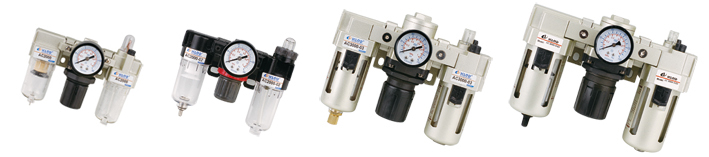
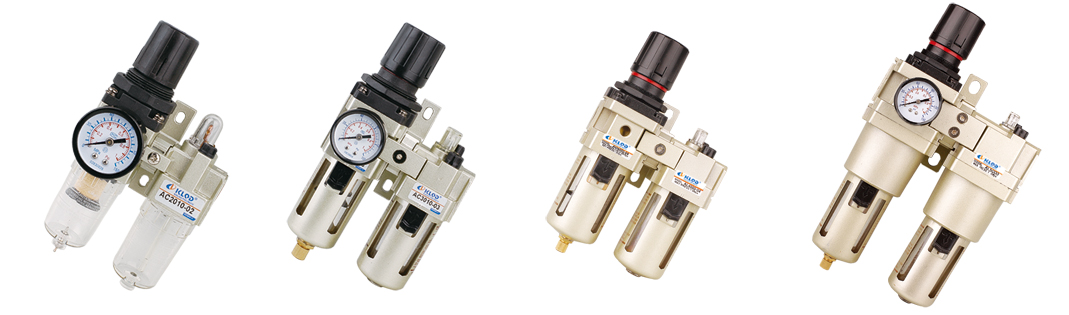
For OEM machinery builders, system integrators and distributors, Kailing can support FRL series selection such as the AC1000-5000 series combination units shown above, along with matching valves and actuators for the same circuit. When sending an inquiry, include your air flow demand, working pressure, filtration requirement and installation environment — this allows the most suitable series and configuration to be confirmed quickly.
Need help selecting the right FRL unit? Contact Kailing with your application parameters for a technical recommendation.
FAQ
What does FRL mean in pneumatics?
FRL stands for Filter, Regulator and Lubricator. It is a combined air preparation unit that removes contaminants, stabilizes pressure and, when required, adds lubricant mist to compressed air.
Do I always need a lubricator in an FRL unit?
No. Many modern pneumatic valves and cylinders are designed for oil-free operation. Check the downstream component specifications; a filter-regulator (FR) combination is often sufficient.
What filtration grade should I use for standard pneumatic valves?
Use the air-quality requirement of the most sensitive downstream component and match it to the documented filter model, element, flow and pressure conditions. Confirm water, oil-aerosol and oil-vapor requirements separately; coalescing filtration alone does not establish an oil-free process.
What happens if the FRL unit is undersized?
An undersized unit creates excessive pressure drop when air demand peaks, causing slow actuation, unstable pressure and premature component wear.
Where should the FRL unit be installed?
As close as practical to the equipment it protects, and upstream of all valves and actuators in the served circuit. Filter bowls generally require vertical installation.
Need a quotation?
Send the page link, quantity, drawings and working conditions to Kailing for review.