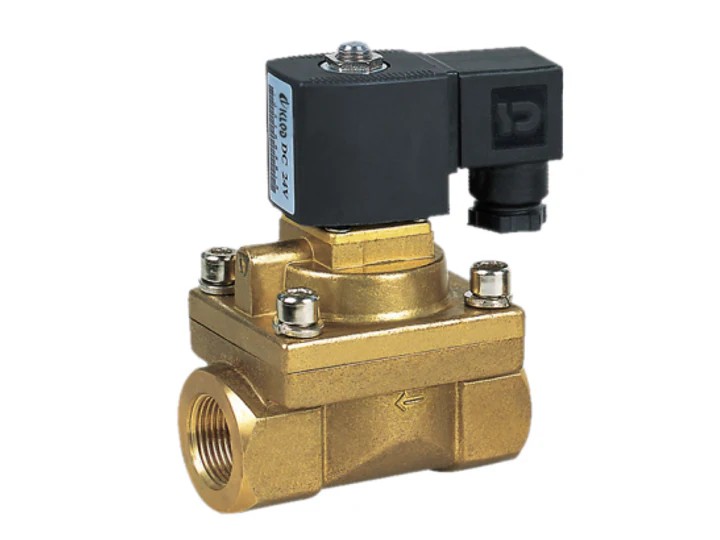
How a High-Pressure Solenoid Valve Works: A Practical Guide to the KL523 Series
When a pipeline runs at 3-50 bar, an ordinary low-pressure solenoid valve is often not enough. The seat has to stay closed against a strong push from the fluid, yet still open quickly when the coil is energized. That is where a piston-type high-pressure solenoid valve becomes useful. This guide explains, in plain language, how the KL523 series from Ningbo Kailing Pneumatic controls water, gas and liquefied gas lines, and where this type of valve is used around the world.
What does a high-pressure solenoid valve actually do?
A solenoid valve is an electrically operated switch for fluids. Inside the valve, a coil receives current from a control panel and creates a magnetic field. The magnetic force moves a metal plunger, and that movement opens or closes a small passage. In the KL523, the main sealing element is a piston rather than a small diaphragm.
This difference matters at high pressure. A diaphragm valve depends more on the elastic membrane and spring. A piston valve sits in a machined bore, so the line pressure itself helps press the sealing face against the seat. When pressure rises, the piston is loaded more firmly and the seal becomes more stable. When the coil is energized, the valve changes state and allows the medium to pass.
In short, the KL523 converts an electrical signal into a mechanical on/off action, and its piston construction is designed to stay reliable in the 0.3-5.0 MPa pressure band, roughly 3-50 bar.
Why the KL523 is normally closed
The KL523 is a two-position, two-way, normally closed solenoid valve. In the de-energized position, the inlet and outlet are separated and the valve keeps the line closed. When power is supplied, the piston opens and fluid can flow.
This arrangement is common in safety-sensitive circuits. If a power failure occurs, the valve returns to the closed position, which helps isolate the supply. That behavior is useful for gas lines, liquefied-gas systems, dosing equipment and pressurized water circuits where uncontrolled discharge would be risky or wasteful.
Which KL523 model fits which pipeline?
The KL523 range is divided into five port sizes. The three smaller models cover the full 0.3-5.0 MPa range, while the two larger models are rated to 3.5 MPa because their larger bores put more load on the piston and seat.
| Model | Port size | Working pressure |
|---|---|---|
| KL5231008 | 1/4 in | 0.3-5.0 MPa |
| KL5231010 | 3/8 in | 0.3-5.0 MPa |
| KL5231015 | 1/2 in | 0.3-5.0 MPa |
| KL5231020 | 3/4 in | 0.3-3.5 MPa |
| KL5231025 | 1 in | 0.3-3.5 MPa |
The lower limit is just as important as the upper limit. A piston valve usually needs a minimum differential pressure to seal and operate predictably. The KL523 range starts at 0.3 MPa, so a line that runs close to zero pressure should not be specified with this series without technical review.
What media can it handle?
The standard catalog lists water, gas, acetylene, liquefied gas and other fluid media with a kinematic viscosity up to 1 mm2/s. The medium temperature limit is 180 C. This makes the series suitable for both liquid and gaseous circuits, provided the pressure and media match the specification.
For buyers, the practical rule is simple: always name the exact medium. Water, town gas, liquefied petroleum gas and acetylene behave very differently in terms of lubricity, temperature and sealing requirements. If the fluid is corrosive, the manufacturer should know the chemical name and concentration before confirming a seal and body combination.
Where is a high-pressure solenoid valve used?
High-pressure solenoid valves appear in many industries, from automated factories to municipal utilities. Typical KL523 applications include:
- Industrial water systems: pressure boosting lines, rinse circuits, high-pressure cleaning rigs and process water dosing.
- Gas supply and burner circuits: controlled shutoff for gas trains, test benches, pilot lines and small production equipment.
- Liquefied-gas installations: vapor or liquid lines in cooking-gas systems, bottling plants and industrial fuel supply.
- Welding and cutting gas distribution: acetylene or similar fuel-gas circuits where an electrically controlled shutoff is required.
- Machine building and OEM equipment: compact on/off control inside compressors, hydraulic-adjacent circuits, pressure test rigs and packaged machines.
- Global infrastructure projects: car-wash equipment, food and beverage washdown areas, fire-testing rigs, irrigation control and laboratory pressure systems.
Because the coil is fully encapsulated and rated IP65 to IEC 60529, the valve is also appropriate for dusty or wet environments such as plant rooms, washdown zones and outdoor enclosures. The rating does not make the valve suitable for continuous immersion, but it protects the coil against dust and water jets.
How to choose the coil voltage
The KL523 catalog offers AC 24 V, 36 V, 110 V, 220 V and 380 V coils at 50 or 60 Hz, plus DC 12 V and 24 V coils. This range covers common industrial standards in Europe, North America, Southeast Asia, the Middle East and South America.
The correct choice depends on the control panel, not on the main line. If a machine uses a 24 V DC PLC output, a DC 24 V coil keeps the wiring simple. If the valve is powered directly from a local AC supply, the panel voltage and frequency must match the coil marking. The listed power is 8 VA for AC and 14 W for DC, so the circuit designer can size the power supply and protection devices accordingly.
For hazardous areas, the ordering code includes explosion-proof coil variants marked Z or ZT6 with T4/T6 temperature-class options. In those projects, the buyer should always send the area classification and required marking so the matching certificate and declaration can be checked.
Why thread standards matter in a global project
A valve can work perfectly on the test bench and still become a problem on site if the thread does not match the pipe. The KL523 can be supplied with G, ZG or NPT threads. G threads follow ISO 228-1, ZG is the tapered pipe thread commonly used in Chinese and related standards, and NPT follows ASME B1.20.1.
For global procurement, the safest approach is to specify the thread standard explicitly. Saying "1/2 inch" is not enough. A European line may expect G, while a North American line may expect NPT. Matching the mating connection avoids leakage, damaged threads and costly adapters.
A quick checklist before ordering
| Item | What to confirm | Why it matters |
|---|---|---|
| Medium | Water, gas, acetylene, liquefied gas or other fluid | Determines sealing and compatibility |
| Pressure | Full working range, not only peak pressure | The series starts at 0.3 MPa |
| Temperature | Normal and maximum medium temperature | Catalog limit is 180 C |
| Port size | 1/4, 3/8, 1/2, 3/4 or 1 in | Selects the KL523 model |
| Thread | G, ZG or NPT | Must match the installed pipework |
| Coil | AC or DC voltage, frequency and duty cycle | Must match the control circuit |
| Environment | Dust, washdown, outdoor or hazardous area | Determines coil protection and certification |
| Quantity | Project quantity plus recommended spares | Affects production planning and delivery |
Frequently asked questions
Can a KL523 valve be used on a 0.2 MPa line?
Not as a standard selection. The KL523 working pressure starts at 0.3 MPa, so a lower-pressure line should use a valve selected for that condition.
Is KL523 suitable for both water and gas?
Yes, the catalog lists water, gas, acetylene, liquefied gas and other fluid media within the stated viscosity, pressure and temperature limits.
What makes it a high-pressure solenoid valve?
It uses a piston structure and is rated for a 0.3-5.0 MPa working-pressure band on the smaller models, compared with many common solenoid valves intended for lower-pressure service.
Can it be used outdoors?
The fully encapsulated coil is IP65 rated to IEC 60529, which protects against dust and water jets. Confirm ambient temperature, connector form and whether the installation needs additional protection.
Can Kailing supply the KL523 as an OEM product?
Yes. The ordering code covers port, thread, coil type and voltage, and private-label marking and packing can be discussed for volume orders. Non-standard body materials or seals require technical review.
Need a KL523 drawing or quotation?
Send the medium, working-pressure range, port size, thread standard, coil voltage, environment, quantity and delivery requirement. A photo or drawing of the existing valve is also helpful for replacement projects, because it allows the factory to confirm dimensions and the connection standard before production.
Need a quotation?
Send the page link, quantity, drawings and working conditions to Kailing for review.