
Direct Answer
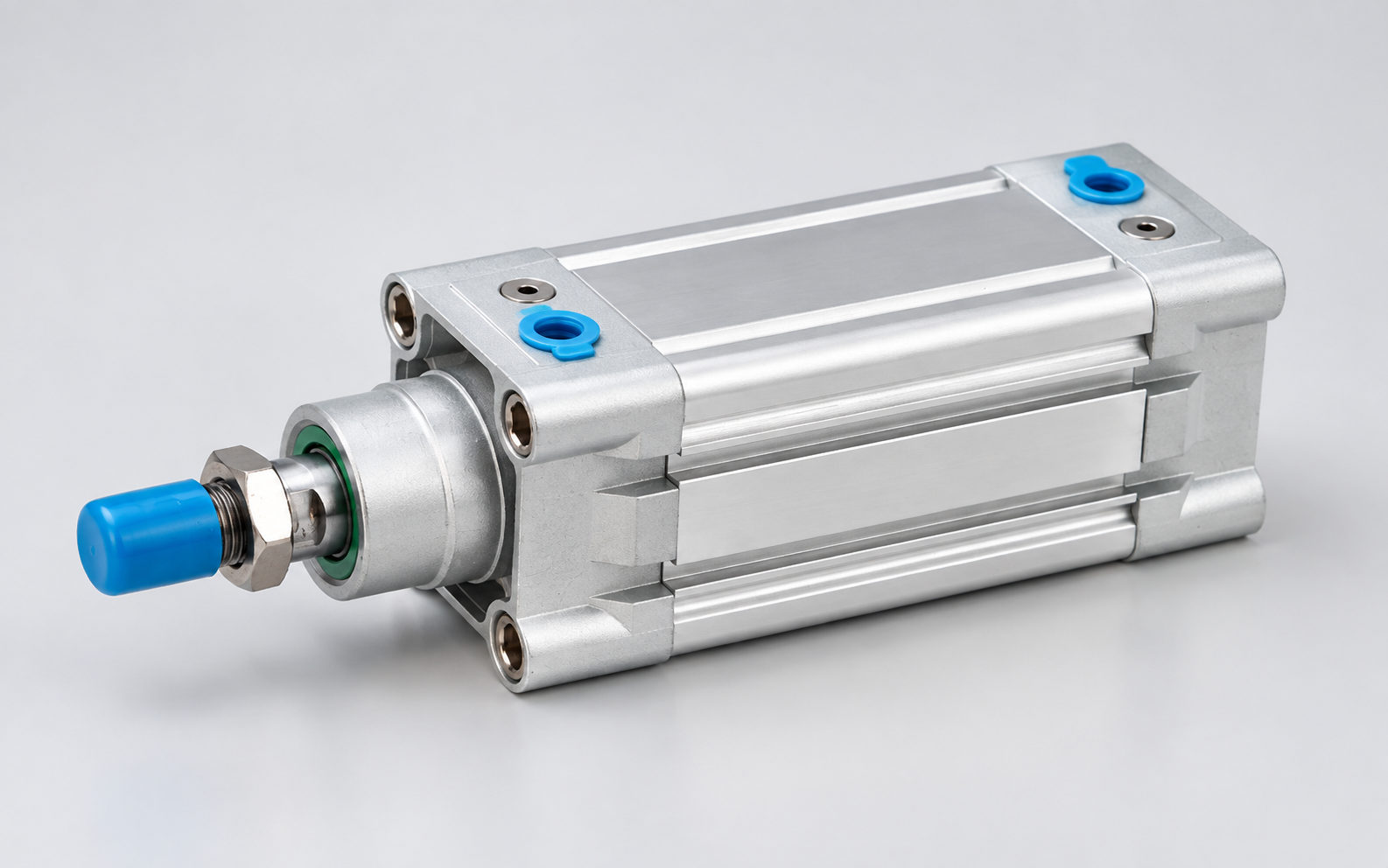
An ISO 15552 pneumatic cylinder, commonly known as a DNC type, is a metric-standard actuator with interchangeable mounting dimensions defined by ISO 15552. To choose one for OEM applications, confirm your required bore size, stroke length, cushioning type, mounting style, sensor groove and seal material. Match these to your operating pressure, temperature and cycle rate, then verify the dimensional drawing before ordering.
Introduction
An ISO 15552 pneumatic cylinder (DNC type) is a square-profile metric actuator that follows a global standard for interchangeable mounting and rod dimensions. For OEM buyers, the advantages are clear: the DNC profile allows you to source the same footprint and stroke from multiple suppliers. The catch is that ISO 15552 is a family of dimensions, not one fixed model — so you must specify bore, stroke, cushioning, sensors and rod-end thread.
Buyer Selection Checklist
| Parameter | What to confirm | Why it matters |
|---|---|---|
| Bore size | 32/40/50/63/80/100/125/160/200 mm | Determines force output at operating pressure |
| Stroke length | Working travel plus margin | Oversized strokes waste space; too short fails |
| Cushioning | Adjustable vs fixed, pneumatic vs air | Controls impact at end of stroke |
| Mounting style | Foot, flange, trunnion, tie rod | Must match machine interface |
| Sensor groove | Integrated slots for magnetic switch | Enables position feedback without extra hardware |
| Seal material | NBR, PU, FKM, PTFE | Must be compatible with media and temperature |
| Rod end thread | From ISO 15552 standard | Must mate with customer hardware |
| Operating temperature | -20°C to +80°C (typical) | Confirm with datasheet |
Key Selection Criteria
Bore Size and Force
The theoretical force of a pneumatic cylinder is the product of the effective piston area and the working pressure. For an ISO 15552 DNC cylinder with a 63 mm bore, the approximate push force at 0.6 MPa is around 1.8 kN. For real applications, add a 25-30% safety factor for friction, side loads and pressure losses. If you need a higher force, either increase the bore or the supply pressure, but check the pressure receiver.
Stroke Length and Buckling
For stroke lengths above about 10 times the bore size, column buckling becomes the limiting factor. A 200 mm-stroke DNC cylinder with a 32 mm bore is fine; a 1000 mm stroke on the same bore needs a larger rod or guide. Confirm the effective buckling load with your cylinder supplier's chart.
Cushioning
DNC type cylinders generally have adjustable end-of-stroke cushioning. For fast-moving loads, specify adjustable pneumatic cushioning. For slow or light loads, fixed cushioning is enough and costs less.
Mounting and Sensor Grooves
ISO 15552 defines several mounting styles such as foot, flange, trunnion and tie-rod. Choose the style from the machine drawing, not from availability. For position feedback, ask for integrated magnetic sensor grooves — these slots let you mount reed switches or solid-state sensors on the cylinder body.
Seal and Material Compatibility
Standard NBR seals work for most compressed air systems. If your plant uses special lubricants or high ambient temperatures, ask about FKM (Viton) or PU seals. Always confirm the rod and barrel material: standard is aluminium alloy with hard-anodised barrel and chrome-plated rod.
OEM Customisation Options
ISO 15552 leaves some room for customisation:
- Non-standard stroke lengths are available because the barrel can be machined to any length between minimum and maximum.
- Rod material can be upgraded to stainless steel for corrosive environments.
- Special lubrication can be requested for food-grade or high-cycle applications.
- Custom packaging or logo printing is available for OEM branding.
FAQ
What is the difference between ISO 15552 and ISO 6431?
ISO 6431 was the older standard for cylinders with detachable mountings. ISO 15552 replaced it. If a drawing references ISO 6431, most ISO 15552 cylinders are compatible, but always verify the specific dimensional chart.
What is the typical MOQ for a DNC cylinder?
MOQ depends on the supplier and the size. For standard bore sizes, samples are often available at higher unit prices. Contact us directly to confirm MOQ for your required model.
How do I confirm the cylinder is truly compliant?
Ask for the technical drawing and the specific ISO 15552 dimensional table. We will provide drawings for your verification.
Can you provide samples before bulk order?
Yes. We can provide samples. Please confirm the order details first.
Natural inquiry CTA
Need an ISO 15552 DNC cylinder for your production line or machine project? Send your bore size, stroke, cushioning requirement and operating conditions to our team, and we will confirm the model and drawing.
Review the existing DNC cylinder reference and drawing and confirm the exact mounting dimensions, cushioning, stroke and document scope before accepting an alternative.
Need a quotation?
Send the page link, quantity, drawings and working conditions to Kailing for review.