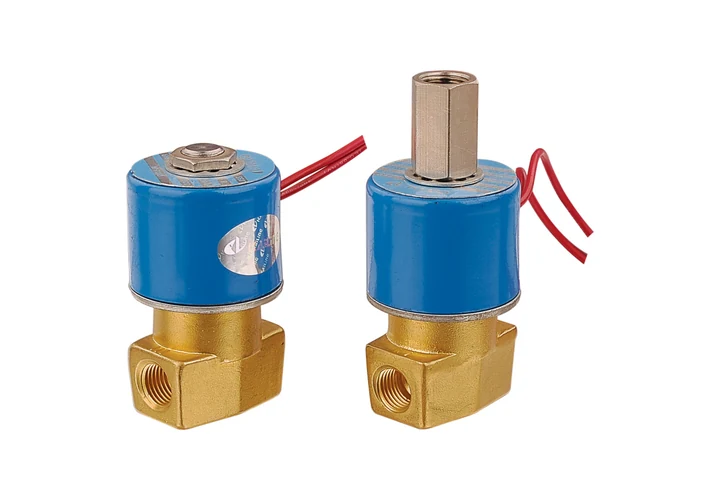
Every vacuum packaging machine runs on the same repeating cycle: pull the chamber down to vacuum, hold it while the bag seals, then break the vacuum so the lid releases. The valve that switches between pump and vent must open from zero pressure differential, because a vacuum line has no pressure left to drive a pilot. The Kailing QX23 is a two-position, three-way direct-acting solenoid valve built for exactly this duty, in a compact L41 x H95 body that slips into tight packaging-machine frames and keeps cycling all shift.
Key takeaways
- QX23 is the two-position three-way (function code 23) member of the QX direct-acting family: one valve handles vacuum draw, hold and vent.
- Direct acting means it opens from zero pressure differential - the property a vacuum circuit actually needs.
- Two catalog sizes, QX23-08 (1/4 in) and QX23-10 (3/8 in), cover 0-0.9 MPa with AC 10 W / DC 13 W coils and five voltage references.
- Seal options NBR, EPDM, VITON and silicone let you match the valve to media and temperature, and OEM programs are supported by the manufacturer.
Why the three-way function matters on a vacuum packaging machine
A two-position three-way valve has one common port that connects to one of the other two ports at a time. That single behavior is the backbone of a packaging chamber's control circuit:
| Cycle phase | Valve position | Result |
|---|---|---|
| Vacuum draw | Chamber connected to pump port | Chamber and bag are evacuated |
| Hold / seal | Position maintained | Vacuum held while the seal bar works |
| Vent / vacuum break | Chamber connected to vent port | Air returns, lid releases, product moves on |
One valve handles the switch between pump and vent. That is why packaging-machine builders keep coming back to the 3-way configuration instead of adding a second two-way valve - fewer components, fewer wiring points, fewer parts to service. If your circuit also needs a dedicated gas-flush or backfill line, that duty is normally handled by a separate two-way valve; send us the circuit and we will confirm the right split.
Why a vacuum line needs a direct-acting valve
This is the most common selection mistake on packaging machines, and it costs the most downtime. A pilot-operated valve needs a minimum pressure differential to lift its piston or diaphragm. In a chamber approaching vacuum, that differential disappears - both sides of the seat sit near the same low pressure - so a pilot valve sticks closed or reacts late, right in the middle of a production run.
The QX23 is direct acting: the coil alone moves the seal. The valve operates from zero pressure differential, cycle after cycle, and responds consistently at the high cycling rates that a packaging line demands. For buyers, that means fewer mid-shift faults and a cycle time you can set and forget.
What does the QX23 range cover?
| Model | Connection | Orifice (catalog) | Pressure differential | Dimensions | Power |
|---|---|---|---|---|---|
| QX23-08 | 1/4 in | top 2.3 mm / body 1.6 mm | 0-0.9 MPa | L41 x H95 | AC 10 W / DC 13 W |
| QX23-10 | 3/8 in | top 2.3 mm / body 1.6 mm | 0-0.9 MPa | Confirm with us | AC 10 W / DC 13 W |
The 0-0.9 MPa window covers both sides of packaging duty: deep vacuum on one phase and compressed-air service on another. The compact footprint matters too - the 1/4 in model is 41 mm long and 95 mm high, leaving room in dense machine frames where every millimetre of manifold space counts.
Which seal and temperature range should I specify?
| Seal | Code | Media temperature (catalog) | Typical fit |
|---|---|---|---|
| NBR | blank | -5 C to +80 C | General air and vacuum duty |
| EPDM | E | -10 C to +120 C | Hot water and water-based media |
| VITON | V | -10 C to +150 C | Higher temperature and aggressive media |
| Silicone | SI | -15 C to +150 C | Low-temperature flexibility |
The QX family is catalogued with a high-quality fluoro-rubber seal as standard for neutral gas and liquid media, including compressed air, natural gas, water, hydraulic oil and process vacuum. On packaging machines the working medium is usually air, but washdown environments, warm product zones and cleaning chemicals can raise the temperature or compatibility requirement - that is exactly what the seal code is for. Tell us the worst case your valve will see, not just the average case.
Which coil, voltage and protection options apply?
QX23 voltage references from the catalog are AC 380 V, AC 220 V and AC 36 V, plus DC 220 V and DC 24 V, with coil power of AC 10 W or DC 13 W across both sizes. Two coil formats are available - a round coil and a square IP65 coil - so protection against dust and washdown splash can be specified rather than hoped for.
For export machinery builders this spread is practical: one valve platform follows the control cabinet voltage of each destination market, so you quote the same machine design worldwide and only the coil reference changes.
How do I choose the right configuration?
Working through five questions removes most selection mistakes:
- Function. Two-position three-way, normally closed or normally open relative to your circuit - state which port is common in your plumbing.
- Port and thread. 1/4 in (QX23-08) or 3/8 in (QX23-10); confirm the thread standard, G, ZG or NPT, before quotation so the valve bolts onto your manifold without adapters.
- Pressure duty. The full range the valve sees, vacuum phase and any positive phase; 0-0.9 MPa is the catalog boundary.
- Media and temperature. Air, nitrogen, water or cleaning media, plus ambient and media temperature - this picks the seal code.
- Coil. AC or DC, voltage, and round or square IP65 coil format.
Buyer checklist before an RFQ
Copy this list into your inquiry - it shortens the quotation loop to one round:
| Item | What to state | Why it matters |
|---|---|---|
| Function | 3-way draw/vent circuit, NC or NO | Sets the wiring and plumbing logic |
| Ports | 1/4 in or 3/8 in, thread G/ZG/NPT | Must match the manifold |
| Pressure | Vacuum level and any positive duty | Confirms the 0-0.9 MPa window fits |
| Media and temperature | Air or other media, normal and peak | Drives the seal choice |
| Cycling | Expected cycles per hour or per shift | Confirms duty suitability |
| Coil | Voltage (AC 380/220/36, DC 220/24) and coil format | Must match the panel supply |
| Quantity | Pieces per order, plus spares | Delivery and packing |
Can this valve be supplied as an OEM or custom build?
Yes - and this is where a manufacturer rather than a trader makes the difference. The QX ordering code already fixes the orifice, port, seal, coil format and voltage, so a private-label or OEM program is built around those choices plus marking and packing. Ports, thread standards and seal combinations can be matched to your machine series, and replacement projects for existing packaging machines start from a photo of the valve you use today. Anything outside the standard code goes through an engineering review before quotation, so what you receive is a confirmed design, not a guess.
Frequently asked questions
Can a pilot-operated solenoid valve be used on a vacuum packaging machine?
Not as a standard selection. A pilot valve needs a pressure differential to open, and a chamber approaching vacuum does not provide one. Direct acting is the safe specification.
Can one QX23 handle both vacuum draw and vacuum break?
That is the natural duty of a two-position three-way valve: the common port switches between the pump port and the vent port. Confirm which arrangement, NC or NO, matches your control logic.
Is QX23 suitable for continuous high-frequency cycling?
Direct-acting valves respond consistently at zero differential, which suits repeated packaging cycles. Send your cycling rate and duty so the coil and seal choice can be confirmed.
Can the QX23 replace another brand's compact 3-way valve?
Do not assume a one-to-one swap. Compact solenoid families differ in action, pressure boundary, orifice and port references. Confirm the exact model code and operating conditions before replacement.
Need a QX23 quotation for your vacuum packaging machine?
Send us the function and circuit arrangement, vacuum and positive pressure duty, port size with thread standard, media and temperature, expected cycling rate, coil voltage and quantity. Our engineers will come back with a confirmed configuration - standard catalog item or OEM build - so your next machine ships with a valve that was selected, not guessed.
Need a quotation?
Send the page link, quantity, drawings and working conditions to Kailing for review.