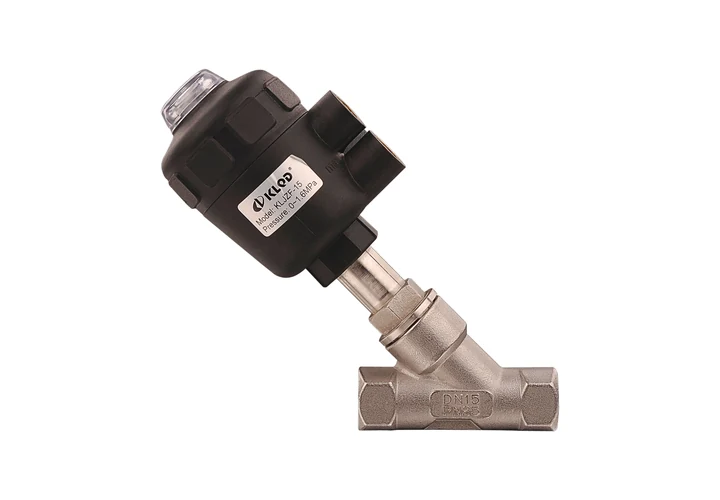
Before specifying a pneumatic angle seat valve for a packaging line, separate the process duty from the compressed-air control requirements. Record the fluid, temperature, inlet and outlet pressure, required flow, pipe connection and available pilot air. Then review the exact KLJZF model, wetted materials, seals and required documents. Steam or wash-water service is a condition to confirm for that configuration, not a capability to assume from the series name.
Start with the task on the packaging machine
Identify what the valve controls: a steam supply, process-water line, wash-water circuit or another service. State whether the fluid contacts the product or food, whether the valve is used in a cleaning circuit, or whether it is only installed near food-processing equipment. These are different requirements.
Use the food and beverage packaging application page to review the available product routes. If you are deciding between pneumatic and electrical fluid control, read the angle seat valve versus solenoid valve guide. A pneumatic valve and a fluid solenoid valve should be compared against the actual control task, not treated as direct replacements because their pipe sizes match.
Keep process pressure and pilot-air pressure separate
Use the following table to prepare the operating details. Mark unknown values as “to confirm” rather than copying a maximum from another model or product family.
| Requirement | Information to send | What the model review must resolve |
|---|---|---|
| Process fluid | Fluid name, composition, concentration and relevant impurities | Compatibility of the proposed wetted parts and seals |
| Process temperature | Normal, minimum and peak temperatures; heating or cooling sequence | Limits for the exact valve configuration |
| Process pressure and flow | Inlet and outlet pressure, minimum differential pressure and required flow | Whether the proposed model meets the actual duty |
| Cleaning conditions | Cleaning-agent name and concentration, temperature, duration and cycle frequency | Compatibility during cleaning as well as normal operation |
| Pilot-air supply | Minimum and maximum air pressure available at the valve | Control-side requirements for the selected actuator configuration |
| Action and failure condition | Required normal state and position after loss of air; separate requirements for loss of power or control signal | Valve action and the behavior of the complete pilot/control circuit |
Process pressure describes the fluid line. Pilot-air pressure describes the air available to operate the valve. Keep both values in the request, together with their measurement location. A process-pressure rating does not establish the required control-air supply.
Where a pilot solenoid or electrical position-feedback accessory is part of the package, also specify its power supply, connector and signal requirements. Coil voltage is an accessory requirement when that electrical device is included; it is not a substitute for the pneumatic valve's pilot-air data.
Match the connection, head type and installation drawing
Start with the KLJZF angle seat valve series and compare the relevant connection pages. The linked configurations distinguish the connection and actuator head; they do not establish that every material, seal or action is available in every combination.
| Candidate connection | Product reference | Drawing and installation details to provide |
|---|---|---|
| Threaded, plastic head | Threaded KLJZF reference | Port size, thread standard, mating connection and available mounting space |
| Flanged, plastic head | Flanged KLJZF reference | Flange standard, mating dimensions, pressure requirement and installation drawing |
| Tri-clamp, plastic head | Tri-clamp KLJZF reference | Mating ferrule dimensions, clamp and gasket requirements, installation space |
| Tri-clamp, stainless head | Stainless-head tri-clamp KLJZF reference | The same pipe-interface checks plus the required head configuration |
Keep actuator-head material separate from the body, internal wetted parts and process seal. A stainless head does not identify the wetted-material grade. A tri-clamp connection alone does not prove food-contact approval or hygienic suitability.
Provide a marked installation drawing or clear photos of the existing valve, flow-direction marking, pipe interfaces and surrounding space. Ask for the proposed model's dimensions and permitted flow direction before accepting it as a replacement. If water hammer is a concern, describe the piping and operating sequence and request a system-level review; a connection type or stainless-material label does not demonstrate that the problem will be eliminated.
Review steam and wash-water conditions by model
For a steam circuit, include the actual pressure and temperature, startup conditions, expected condensate and switching sequence. For process or wash water, include water temperature and any treatment chemicals. For cleaning service, identify each cleaning fluid and its concentration rather than using “CIP” as the complete specification.
Ask which body, internal wetted materials and seal are proposed and request their operating limits for those conditions. Do not select a seal from its generic material name alone. This checklist does not establish universal steam, chemical or direct-food-contact suitability for KLJZF valves.
If an electrically operated steam valve is another candidate for the project, the US(2L) steam solenoid valve selection guide covers a separate product route. Its parameters must not be transferred to a KLJZF model.
Request documents for the exact quoted configuration
Name the target market and the documents required by your project. Where CE-related documentation, material evidence, food-contact evidence or test records are requested, ask whether they are available and applicable to the complete quoted model and configuration. Confirm the document scope and model identification before relying on them.
The Factory & Quality page is a starting point for company information. A company-level certificate or a general product-family description does not establish document coverage for every valve. Likewise, a sample check should use agreed operating conditions and acceptance criteria for the actual application.
Prepare a quotation package with clear supply boundaries
Send the operating table, connection drawing or replacement photos, candidate model if known, quantity and requested documents through the existing contact page. State whether you need the valve alone or a package including a pilot solenoid, feedback device, fittings or other accessories. Ask the quotation to identify each included item and the final model code.
For a requested change to a standard model, provide a marked drawing and the specific difference. Availability of the change, supporting documents, sample terms and production timing require review for that request. Include your target delivery date and ask for confirmed stock and lead time in the quotation; this guide does not promise a fixed dispatch period.
Frequently Asked Questions
- FAQ Does a pneumatic angle seat valve need a coil voltage?
Specify pilot-air requirements for the pneumatic valve. If the quoted package includes a pilot solenoid or electrical feedback device, also confirm the power supply, connector and signal requirements of those accessories. - FAQ Does a stainless actuator head confirm stainless wetted parts?
No. Confirm the body, internal wetted parts, material grades and process seal separately for the quoted model. The head description does not establish the wetted-material specification. - FAQ Does a tri-clamp connection establish hygienic or food-contact approval?
No. Supply the intended service and document requirements and confirm model-specific suitability and evidence separately from the mechanical connection. - FAQ Can a fixed dispatch date be assumed from this guide?
No. Provide the configuration, quantity, requested documents and target date, then confirm stock and lead time in the quotation. - FAQ What should I send before requesting model selection?
Send the fluid and cleaning conditions, temperatures, inlet and outlet pressures, required flow, available pilot air, action requirements, pipe-interface drawing, quantity and requested documents. Mark unknown values for confirmation.
Need a quotation?
Send the page link, quantity, drawings and working conditions to Kailing for review.